Toon Boom as a Standard in Professional 2D Animation
Toon Boom has become a key tool within 2D animation studios working for television, streaming platforms, and film. Its strength lies not only in its drawing tools, but in its ability to support a professional, organized, and scalable workflow. Unlike simpler software, Toon Boom is designed for productions involving multiple artists, constant revisions, and tight deadlines.
This professional approach is reflected in how the software supports every stage of the process, from preproduction to final render, while maintaining visual and technical consistency throughout the project.
Preproduction: Storyboarding and Animatics with Storyboard Pro
The workflow usually begins in Toon Boom Storyboard Pro, a tool specifically designed for visual storytelling. This is where storyboards are created, pacing is defined, camera shots are planned, and the duration of each scene is established. One of its greatest advantages is the ability to generate animatics directly within the software, integrating sound, dialogue, and timing from early stages.
Working this way allows teams to detect narrative issues before moving into animation, reducing costly rework. In addition, direct compatibility with Harmony ensures a smooth transition from storyboard to animation without loss of information.
Character Design and Preparation
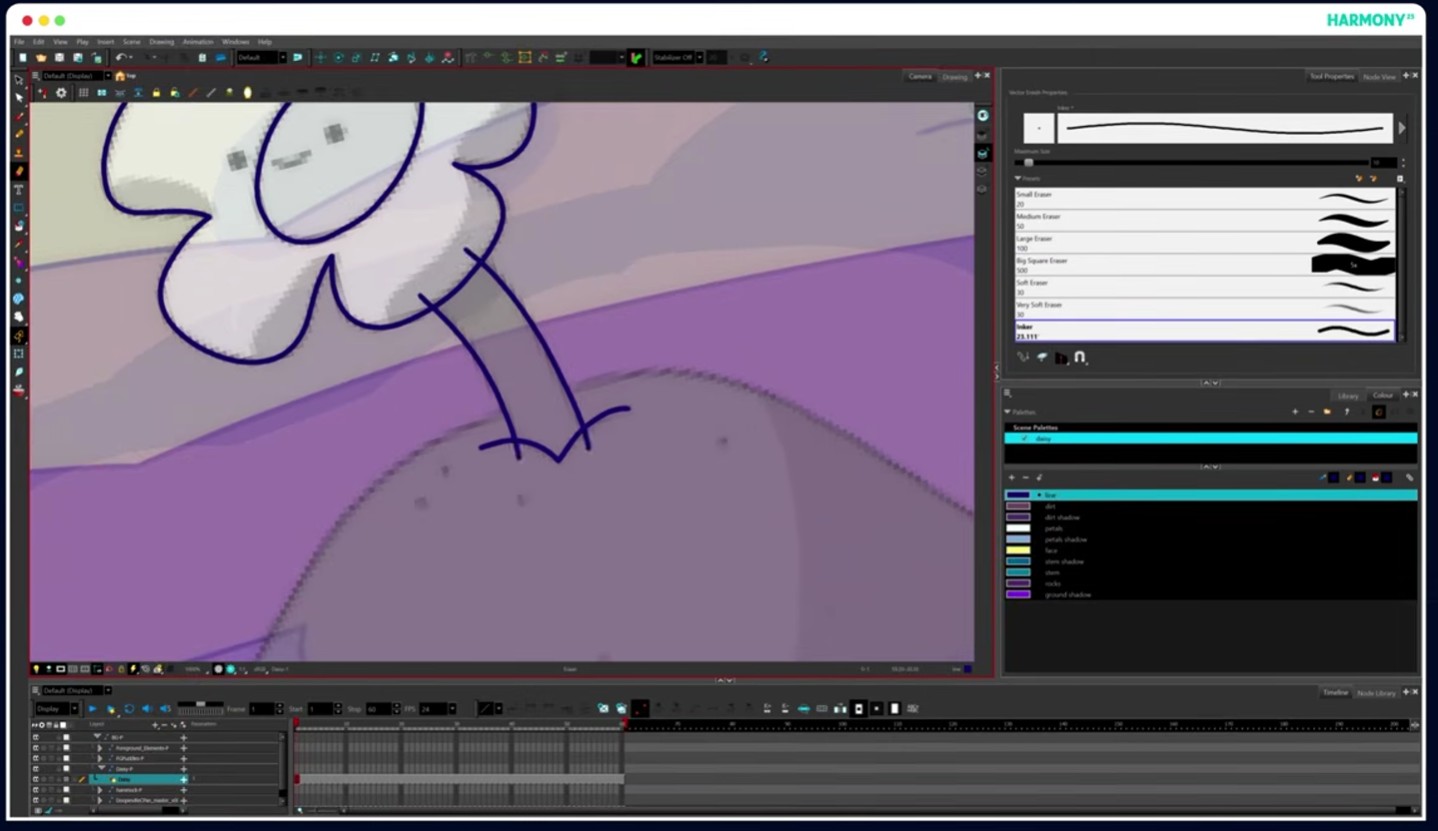
Once the animatic is approved, the process moves into character design and preparation. In Toon Boom Harmony, characters are not created as static drawings, but as structures designed specifically for animation. This includes separating body parts, building hierarchies, and defining controls that will later make the animator’s work easier.
This approach allows characters to be reused across multiple scenes and episodes, maintaining proportions, style, and expressiveness consistently. In long-running productions, this stage is essential for ensuring efficiency and visual stability.
Advanced Rigging and the Use of Deformers
Rigging is one of Toon Boom Harmony’s greatest strengths. Through bone systems, mesh deformers, and custom controllers, characters can move fluidly without the need to redraw every frame. This significantly speeds up production and reduces repetitive work, especially in high-volume series.
Additionally, the node-based system clearly separates animation, deformation, and compositing, making it easier to apply changes without affecting the rest of the project. This level of control is critical in professional environments where technical precision is required.
Animation: Combining Rigging with Traditional Drawing
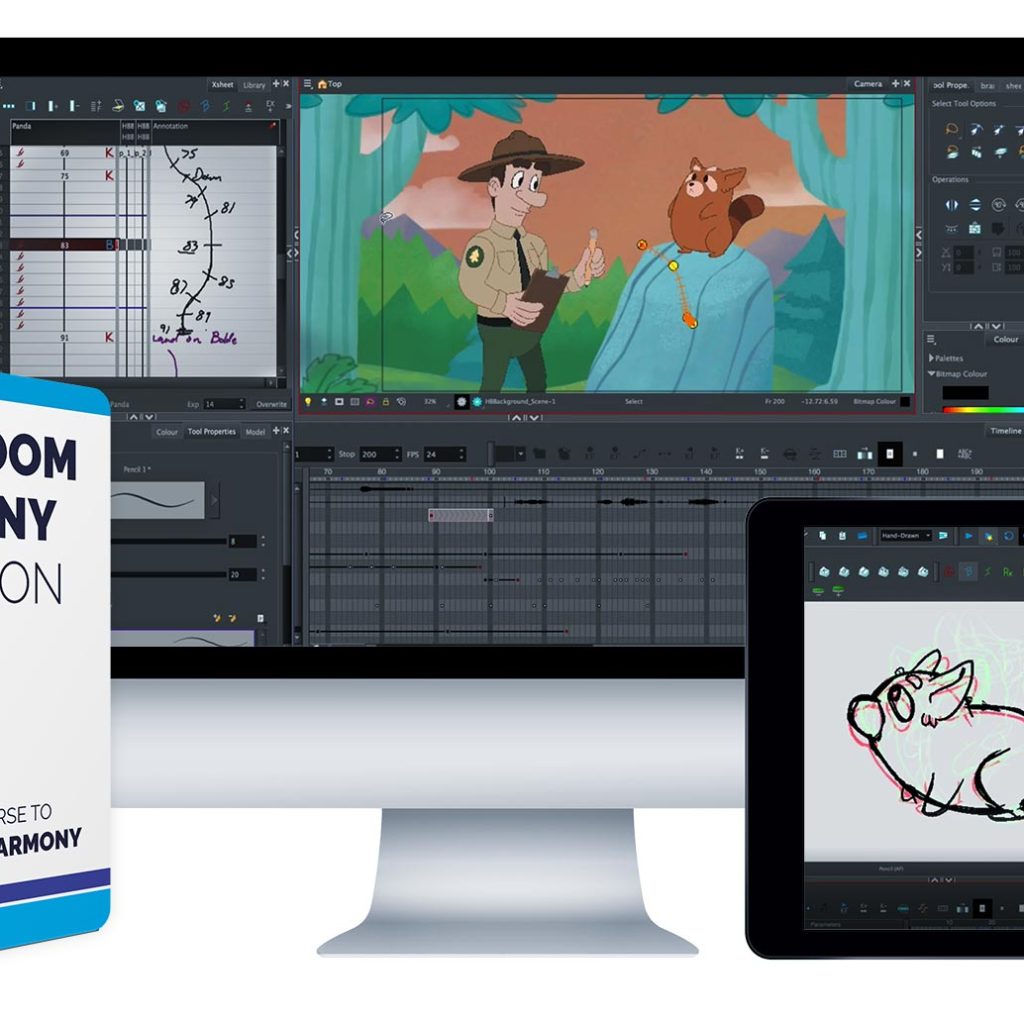
During the animation phase, Toon Boom allows animators to combine rig-based animation with frame-by-frame drawing. This means rigs can be used for general movement while artists manually intervene in scenes that require higher expressiveness or complex actions. This flexibility is one of the reasons the software adapts so well to different styles, from children’s animation to more cinematic productions.
The timeline and interpolation tools help maintain an organized workflow, while advanced controls allow each movement to be refined without losing natural motion.
Compositing, Effects, and Visual Control
Once scenes are animated, Toon Boom Harmony’s node system becomes central to the workflow. Through it, backgrounds, lighting, shadows, atmospheric effects, and virtual cameras are integrated. All of this happens within the same environment, eliminating the need to constantly export to external programs.
This approach not only saves time, but also maintains a unified view of the project. Changes can be applied non-destructively, which is essential in productions where revisions are frequent.
Final Render and Export for Different Formats
The final step in the workflow is rendering. Toon Boom offers multiple export options, adapting to the requirements of television, streaming platforms, or social media. The ability to control resolutions, formats, and layers makes it easier to deliver content to post-production or distribution teams.
Thanks to this integrated pipeline, studios can maintain a stable, repeatable, and optimized workflow, even on large-scale projects.
Why This Workflow Makes a Difference
The real value of Toon Boom lies not only in its individual tools, but in how they integrate into a cohesive workflow. From planning to final animation, the software enables organized, collaborative, and professional production. That’s why it is the preferred choice for studios seeking quality, efficiency, and long-term consistency.